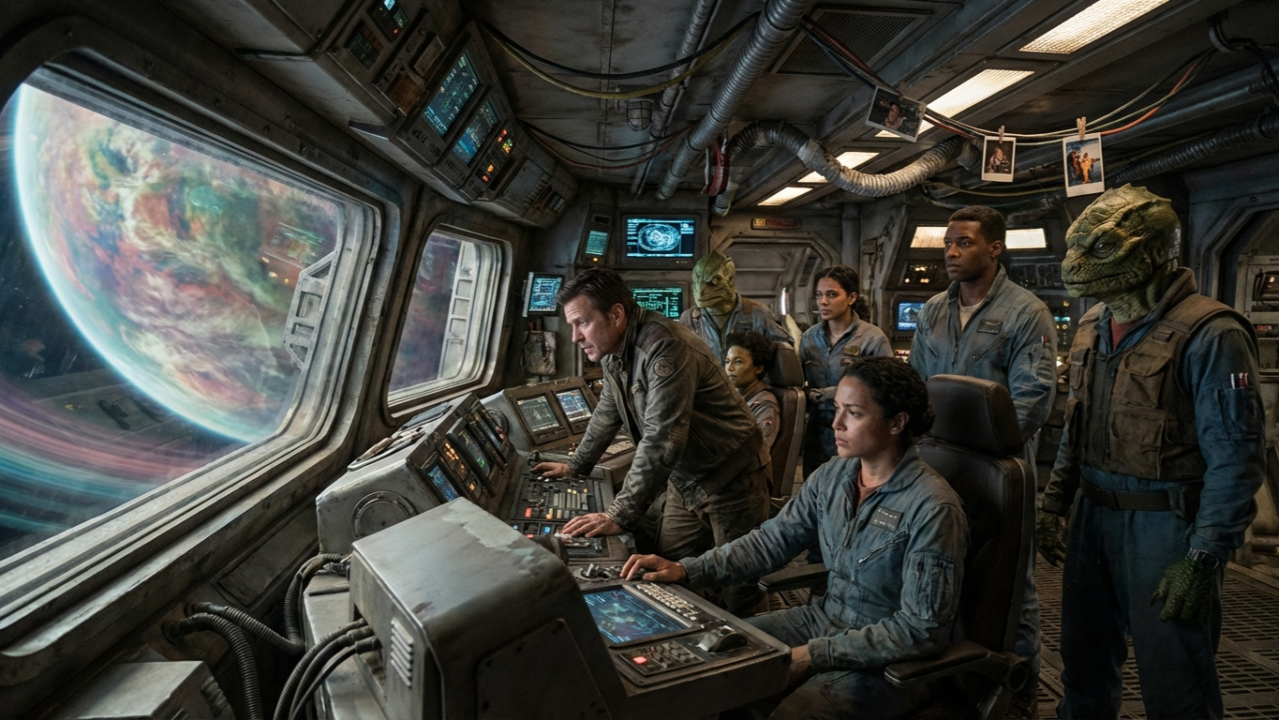
A misquoted futurist, a cognitive linguist, and an alien planet walk into a bar…
There’s a quote you’ve probably seen a hundred times: “The illiterate of the 21st century will not be those who cannot read and write, but those who cannot learn, unlearn, and relearn.” It’s attributed to Alvin Toffler. It’s in every corporate deck about transformation. And it’s wrong — on multiple levels.
The actual words come from psychologist Herbert Gerjuoy, quoted by Toffler in Future Shock: tomorrow’s illiterate will be the person who hasn’t learned how to learn. The polished version everyone shares is a mashup — Toffler’s “learn, unlearn, relearn” language fused with Gerjuoy’s “illiterate of the future” framing, compressed into a bumper sticker by decades of re-quotation.
That misattribution story is itself a perfect example of the problem. We heard a thing, it sounded right, and we stopped checking. We frame-locked.
Frame-Lock: The Cognitive Trap Nobody Talks About
Here’s what happens when your brain encounters ambiguity: it wants to resolve the tension fast. Your amygdala fires, your threat-detection system spins up, and you grab the first explanation that reduces anxiety. That’s frame-lock — the cognitive equivalent of fight-or-flight, but for ideas.
George Lakoff's work on cognitive framing tells us why this matters so much right now. Every piece of content arriving in your feed — every meme, every headline, every hot take — is attempting to install a frame before you can think. The frame is the message. And most people don't even know they're being framed.
This is the landscape we’re all navigating. Memes. Conventional wisdom. Active disinformation. Marketing sensationalism. The frenzy of clickbait. In that chaos stream, the ability to hold multiple interpretations without panicking isn’t just useful. It’s the primary skill that separates people who thrive during transformation from people who get swept away by it.
Critical Thinking vs. Conspiracy Thinking (They’re Not the Same Rebellion)
Here’s the uncomfortable truth that almost nobody in the learning space says out loud: the spectrum from critical thinking to conspiracy thinking isn’t primarily an intellectual problem. It’s a nervous system problem.
Both question official narratives. Both claim to “do their own research.” The mechanism is opposite. Critical thinking holds frames loosely and follows evidence. Conspiracy thinking locks a frame and filters evidence to fit. One is cognitively flexible. The other is cognitive rigidity wearing the costume of independence.
And here’s the thing — conspiracy thinking feels like courage to the person inside it. The relief of locking onto an explanation when you’re anxious is real. The sense of “I see what others don’t” is neurochemically rewarding. The cognitive flexibility just got sacrificed for emotional regulation.
The skill we actually need isn't "think better." It's *notice when your nervous system has grabbed the steering wheel, and build the capacity to hold the discomfort of uncertainty long enough to actually evaluate*.
That’s distress tolerance in the presence of ambiguity. And it’s trainable.
So We Built a Game About It
I wanted to take this idea and make it playable. Not a lecture. Not a quiz. An experience where you feel the pull of frame-lock in real time and learn to resist it.
The result is PATHFINDER: First Contact Protocol — a browser-based minigame where you’re the lead science officer aboard humanity’s first interstellar expedition. You’ve arrived at an alien world. Nothing maps to your prior assumptions. And every scan you run costs energy you can’t get back.
The scoring system doesn't reward getting the right answer fast. It rewards *staying curious longer than feels comfortable*. Players who lock onto a single explanation early score poorly. Players who hold competing hypotheses — who sit with the ambiguity while gathering evidence — discover the deeper truth.
There’s a reason the setting is alien first contact: when you’re the first human to encounter something genuinely new, there is no existing frame. You have to hold multiple interpretations because nobody’s been here before. That strips away all the political and cultural baggage and puts the player in a state of pure curiosity.
The Design Choices That Make It Work
A few deliberate decisions that connect to the learning science:
Limited resources. Your scanner has 100 energy units. Each scan costs 25. There are 5 evidence items per encounter, but you can only afford 4. You always leave something unread. The wisest explorers know which questions to ask and which stones to leave unturned.
- Risky actions. One scan per encounter carries real consequences — provoking unknown organisms, announcing your presence to a planetary system. The best data is expensive. You have to decide: is this worth the cost?
- Detractors. Evidence doesn’t just support hypotheses — it actively challenges others. The thermal scan supports two hypotheses. The composition analysis supports two different ones and undermines a third. Your mental model has to keep updating.
- Multiple truths. Every encounter has more than one correct answer. Reality is always more complex than a single explanation. This IS the lesson. A player who picks just one correct answer scores lower than one who recognizes the full picture.
And the meta-narrative across all six encounters builds toward a revelation that reframes everything you thought you understood. Because that’s what real discovery does.
Play It. Break It. Build Your Own.
The game is live at [**poqpoq.com/adobe/pathfinder](http://poqpoq.com/adobe/pathfinder](https://poqpoq.com/adobe/pathfinder/)) — zero install, works on mobile, takes about 15 minutes.
The entire project is open source on GitHub: [**github.com/increasinglyHuman/discovery](http://github.com/increasinglyHuman/discovery](https://github.com/increasinglyHuman/discovery)). MIT licensed. Fork it, re-theme it, build your own scenarios. The engine handles all the scoring, UI, and state management. You just supply the stories and data.
There’s a full creator guide (CREATING.md) in the repo that walks you through building your own encounter packs — whether you’re a human designer or working with an AI collaborator. The architecture is designed so you can swap the alien planet for an archaeological dig, an underwater expedition, a medical mystery, a business case study — anything where holding multiple hypotheses matters.
Because the muscle we're training isn't domain-specific. It's the same cognitive flexibility whether you're evaluating alien biology, market signals, medical symptoms, or political claims. The frame-lock mechanism doesn't care about the content. It fires whenever ambiguity meets anxiety.
And in 2026, ambiguity is the weather.
Dr. Allen Partridge is a Director of Digital Learning Product Evangelism at Adobe, a learning addict with a rebellious spirit and a passion for evidence-based reasoning. PATHFINDER was built collaboratively with Claude (Anthropic) and scene art generated with Meshy AI.
In part two of this series, I’ll dig into the learning science behind scenario-based training — why branching decisions, resource constraints, and consequence mechanics produce deeper learning than traditional instruction, and how you can apply these principles in your own training programs.
Play PATHFINDER: [poqpoq.com/adobe/pathfinder ]
Fork the repo: [github.com/increasinglyHuman/discovery ]