Every organization has a version of this story. The compliance training that nobody internalized. The leadership program that changed nothing about how people actually lead. The on-boarding sequence that filled heads with information and left behavior completely untouched.
We call these failures engagement problems. Or retention problems. Or motivation problems. We redesign the interface, shorten the modules, add gamification, measure completions more carefully.
We almost never ask the question that would actually explain the failure: did the training ever reach the psychological layer where behavior lives?
In most cases, it didn’t. And that’s not an accident. It’s a design choice — made by a field that has known better for sixty years and decided not to go there.
The domain we abandoned
In 1956, Benjamin Bloom and his colleagues gave learning designers a three-part map of human development: the cognitive domain (knowing and thinking), the psychomotor domain (physical skill), and the affective domain (beliefs, values, attitudes, emotional orientation).
Corporate L&D embraced the first. Acknowledged the second when necessary. And quietly set the third on a shelf where it has been gathering dust ever since.
The reasons are understandable. The affective domain is harder to measure. It makes organizations uncomfortable — it implies that changing behavior means engaging with who people are, not just what they know. It borders on territory that feels personal, psychological, risky.
But here’s what we walked away from when we abandoned it: behavior is not a cognitive output. Behavior is the expression of a belief system in context. What a manager actually does under pressure reflects their values, their threat responses, their internalized models of what safety and success look like — not their score on the post-training assessment.
You cannot train behavior by filling the cognitive domain and hoping the affective domain follows. It doesn’t work that way. It has never worked that way. And the evidence is everywhere in our failed programs.
Ambiguity as the diagnostic
Here is where the mechanism becomes visible.
Every intelligent system — biological or artificial — operates from a working model of its environment. When incoming information fits that model, processing is efficient. When it doesn’t fit, the system registers perturbation: a disturbance at the boundary between what is known and what isn’t.
Ambiguity is the purest form of perturbation. It's not just missing information — it's a mismatch signal that demands resolution. And until it resolves, the system cannot stand down.
The neuroscience here is precise. The brain is fundamentally a prediction machine, constantly generating and updating models of its environment. When those predictions fail — when reality doesn’t match the model — a signal fires that pulls resources toward resolution. If that signal gets routed through the threat-appraisal pathway, the result is defensive narrowing, hypervigilance, cognitive resource hoarding, and eventually exhaustion. The body prepares to fight something it can’t locate. That preparation is metabolically expensive and generates nothing.
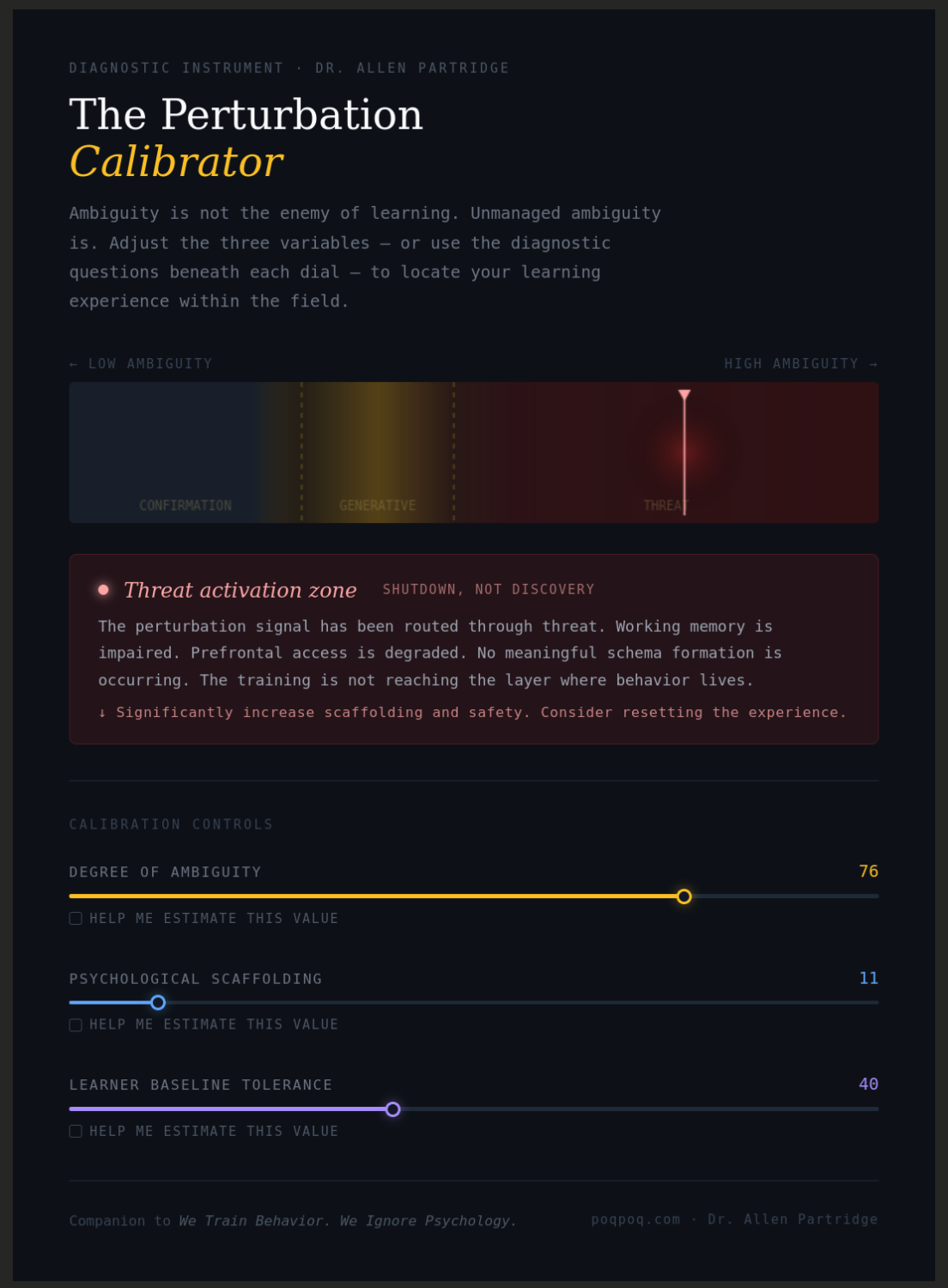
The Perturbation Calibrator is available online: poqpoq.com/adobe/perturb/
This is why ambiguity can be physically exhausting even when “nothing happened.” You didn’t lift anything. You sat in a meeting where the outcome was unclear, or read a memo that could mean several different things, or tried to learn something that didn’t connect to anything you already knew. And hours later, you’re depleted. The exhaustion is real. Its source is a sustained incomplete activation loop in a nervous system that was trying to resolve something that wouldn’t resolve.
Now here’s the part that matters for learning design: every meaningful learning experience is, by definition, a perturbation event. If a learner isn’t experiencing some degree of mismatch between what they thought they knew and what they’re encountering, they’re not learning — they’re confirming. They’re in the cognitive equivalent of cruising.
Real learning requires disequilibrium. Piaget said this explicitly. Vygotsky built an entire pedagogy around the productive edge of not-quite-knowing. Kahneman’s System 2 — the slow, deliberate thinking that actually builds new mental models — only engages when fast, automatic processing fails. You cannot learn anything genuinely new without perturbation.
And yet most training design treats perturbation as the enemy. We reduce ambiguity, sequence content carefully, provide clear objectives, scaffold every step. We confuse the outcome of learning (clarity) with the condition for it, and we design accordingly. The result is training that confirms rather than transforms.
Notice This
Note what just happened, if it happened: a small resistance, a professional defensiveness, an impulse to qualify or rebut. That’s the perturbation signal. The question the rest of this article asks is what you do with it.
The split that determines everything
Here is what the research on stress, cognition, and emotional regulation consistently shows: the exhaustion and shutdown that ambiguity can produce are not inevitable responses. They are conditional responses — conditional on how the perturbation signal gets appraised.
When the inner system reads ambiguity as threat, the cascade runs predictably: defensive narrowing, hyper-vigilance, depletion. When it reads ambiguity as interesting — as invitation rather than violation — the same signal routes differently. Exploration replaces defense. The unresolved becomes a space to move through.
The routing decision happens faster than conscious thought. And it is profoundly shaped by the psychological environment the learner is in.
This is where the “safe space” concept has been so badly misunderstood — dismissed as a feelings amenity, a cultural nicety, something for the emotionally fragile. The neuroscience tells a different story. Psychological safety is a cognitive prerequisite. When threat activation is elevated, working memory is demonstrably impaired. Prefrontal access — the part of the brain doing the careful, schema-building work of actual learning — is degraded. The learner is physically less capable of encoding, integrating, and transferring knowledge.
You cannot memorize complex sequences reliably under threat. You certainly cannot change behavior under threat. The most sophisticated instructional architecture ever designed will fail against a nervous system in defensive mode. Every time.
So the question isn’t whether the affective domain matters. It’s whether we have the professional courage to design for it.
The professionals who have quietly solved this
There are entire disciplines built on deliberate practice with ambiguity — though they rarely use that framing.
Clinicians learn to stay regulated while holding another person’s unresolved pain. Actors train to live inside unresolved character motivation for months. Philosophers are professionally rewarded for sitting with questions that may never resolve. Researchers spend careers productively uncertain. What they share is not a personality trait. It’s a trained interior posture: a learned capacity to hold the perturbation signal without routing it through threat.
The clinical literature — across cognitive behavioral approaches, acceptance-based models, and more recent parts-based frameworks — points to the same underlying mechanism. What distinguishes the regulated professional from the overwhelmed one isn’t the absence of an alarm response. It’s the presence of something that can witness the alarm without being commandeered by it. A metacognitive position that allows simultaneous awareness: this is activating, and this is interesting.
These aren’t mystical capacities. They are developed through repeated, intentional exposure to perturbation within containing structures — supervision, reflective practice, deliberate debriefs, structured exposure to complexity with support available. The field calls this professional development. What it’s actually doing is training the affective layer: calibrating the threat response, building the curious appraisal habit, widening the window within which perturbation is experienced as generative rather than dangerous.
Learning and development could do exactly this. We almost never do.
Structured perturbation as curriculum design
What would it look like to actually design for the affective layer — to treat ambiguity tolerance not as a byproduct of good training but as an explicit outcome?
The constructivist tradition gives us the foundational principle: there is a window within which perturbation is generative. Below it, the learner is bored — confirming rather than constructing. Above it, the learner is overwhelmed — shut down rather than stretched. The art of learning design is precise placement inside that window, with the structural support to keep curiosity appraisal active while the learner is there.

Practically, this means several things that diverge sharply from conventional design:
1. Introduce productive confusion before resolution, not after.
Most courses sequence: explain → demonstrate → practice → assess. Structured perturbation inverts this: present a genuinely puzzling case → let the learner sit with it → facilitate exploration → introduce the framework after the learner has experienced needing it. This sequence activates the constructive process. The framework lands in a mind that has already felt the shape of the problem. It sticks differently.
2. Make the affective experience visible.
What learners rarely get is language for what’s happening inside them during challenge. “Notice that you want this to resolve faster than it’s resolving — that tension is the work.” Naming the perturbation experience helps route it toward curiosity rather than threat. This is psychological scaffolding, and it’s as important as cognitive scaffolding.
3. Calibrate exposure deliberately.
The first encounter with ambiguity should be bounded, low-stakes, and well-supported. Not because learners are fragile, but because you’re building a habit. The threat-appraisal pathway is faster and better-practiced than the curiosity-appraisal pathway for most adults in professional contexts. Rewiring it requires repetition across a gradient — progressively more open, progressively less scaffolded. This is how the clinical professions train emotional regulation. It works.
4. Debrief the process, not just the content.
After a challenging learning experience, standard practice is to review the content. Structured perturbation design adds a second layer: how did this feel? Where did you want to escape? What helped you stay? This reflective process is where the affective learning gets consolidated — where the learner builds an autobiographical narrative of themselves as someone who can tolerate and navigate uncertainty. That narrative is behavior-relevant in a way that content recall almost never is.
None of this requires abandoning rigor. It requires relocating rigor — from the surface of content delivery to the interior architecture of how the learner is prepared, challenged, and held.
Interactive Companion
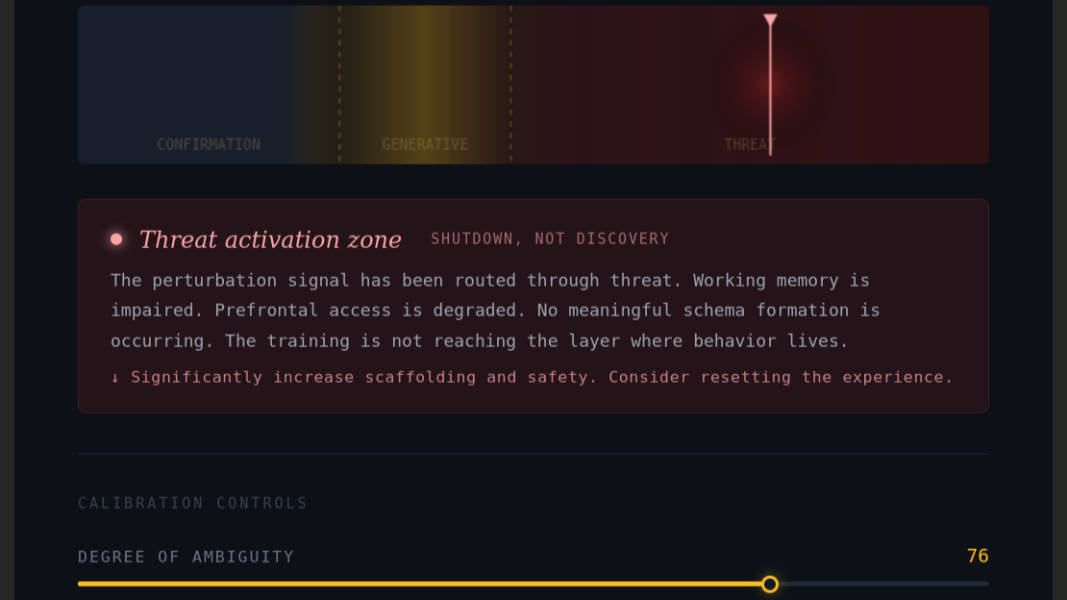
The Perturbation Calibrator lets you adjust ambiguity, scaffolding, and baseline tolerance to locate the generative window for your own learning designs.
What curiosity actually is
Curiosity is often described as a personality trait — something you either have or don’t. The research suggests otherwise.
Curiosity appears to be the experiential signature of a perturbation signal that has been successfully routed away from threat and toward exploration. It feels like interest, pull, energy. Underneath, it's a nervous system reading "unresolved" as opportunity rather than danger.
This means curiosity isn’t the opposite of ambiguity’s discomfort. It’s what happens when that discomfort gets metabolized differently.
It also means curiosity is developable. Not by telling people to be more curious — an instruction roughly as useful as telling someone to be taller. But by building the interior conditions under which the curious routing becomes more accessible, more practiced, more default.
The professionals who work comfortably in sustained uncertainty — the researchers, the clinicians, the artists, the great managers — didn’t arrive that way. They were shaped, by their disciplines and their own deliberate practice, into people whose inner systems had learned to find the unresolved more interesting than threatening.
We could build that in organizations. We have the models. We have the neuroscience. We’ve had the pedagogical theory for decades. What we’ve been missing is the willingness to go where behavior actually lives.
What would your organization look like if ambiguity tolerance were treated as a core competency — designed for, measured, developed deliberately? And what’s actually standing in the way?
Explore the ideas in this article interactively: The Perturbation Calibrator — a diagnostic instrument for locating the generative window in your learning design.
Dr. Allen Partridge is Director of Digital Learning Product Evangelism at Adobe, where he works closely with the team building Adobe Learning Manager and its agentic AI integration as an enterprise learning platform. If questions like “why doesn’t this training fix our behavioral and compliance issues?” keep you up at night in the context of workforce learning, Adobe Learning Manager might be worth a look.