Jensen Huang walked onto the GTC stage yesterday and said something that should stop every product leader, every platform architect, and every indie builder in their tracks.
"Mac and Windows are the operating systems for the personal computer. OpenClaw is the operating system for personal AI."
That’s not a feature announcement. That’s a paradigm declaration. And buried inside it is a business model question nobody is asking loudly enough yet — one that I think represents a genuine billion-dollar opportunity sitting in plain sight.
Let me explain what just happened, why it matters, and what’s still missing.
What Is OpenClaw, and Why Did Nvidia Just Wrap Its Arms Around It?
OpenClaw is an open-source agent platform — think of it as a runtime environment where AI agents don’t just answer questions, they act. They write code, access files, query databases, call tools, and build new capabilities on the fly. It became the fastest-growing open-source project in history almost overnight, spawning an entire ecosystem of “claw” variants as developers realized what it unlocked.
Nvidia’s response? They built NemoClaw — an enterprise stack that installs on top of OpenClaw in a single command, adding the thing enterprises desperately needed: security, privacy guardrails, and policy-based controls for how agents behave and what data they can touch.
Huang also explicitly named Claude Code alongside OpenClaw as the two forces that "sparked the agent inflection point — extending AI beyond generation and reasoning into action."
He compared NemoClaw’s arrival to Linux. To Kubernetes. To HTML. Those aren’t small comparisons. Those are infrastructure analogies — the kind of tools that don’t just change what you build, they change how everything gets built from that point forward.
The Part That Made My Brain Catch Fire
Here’s where it gets interesting for builders, product leaders, and anyone thinking about AI-native applications.
NemoClaw is hardware agnostic. It works with any coding agent. It supports any open-source AI model. And critically — it introduces what Nvidia is calling a “privacy router” that lets agents use frontier cloud models or local models depending on your data sensitivity needs.
Translation: **the AI brain is now hot-swappable.**
You’re not building for a specific model anymore. You’re building a configured intelligence environment — tools, memory, security context, data access — and you drop whatever brain serves your needs into the center of it. Claude for complex reasoning. A fine-tuned domain model for compliance tasks. An open-source model where data absolutely cannot leave your building.
Think about what Adobe Director did in the early days of multimedia — you could fire commands directly into the engine through Lingo without ever opening the application, if you knew the right methods. Deep tool-level access through language. NemoClaw is that paradigm, but for every complex tool ecosystem on earth. Blender. Your enterprise ERP. Your learning management system. Your world-building engine.
The LLM doesn’t need to know all the commands. It just needs to know where the commands live — and remember that the next time.
So Here’s the $1B Question
If the LLM brain is interchangeable, if the agent toolchain is open, if the enterprise security layer is handled — what’s missing?
The billing layer. The consent layer. The identity layer.
Right now, if you want to build a BYO-LLM application — one where users bring their own AI model and inference budget rather than you absorbing the cost — you have two terrible options:
- Ask users to paste in an API key. (Consumer UX death. Nobody does this smoothly.)
- Absorb all inference costs yourself. (MAU growth becomes a cost explosion. Ask anyone building at scale.)
Here’s what I think needs to exist, and what I believe represents a genuine strategic opening:
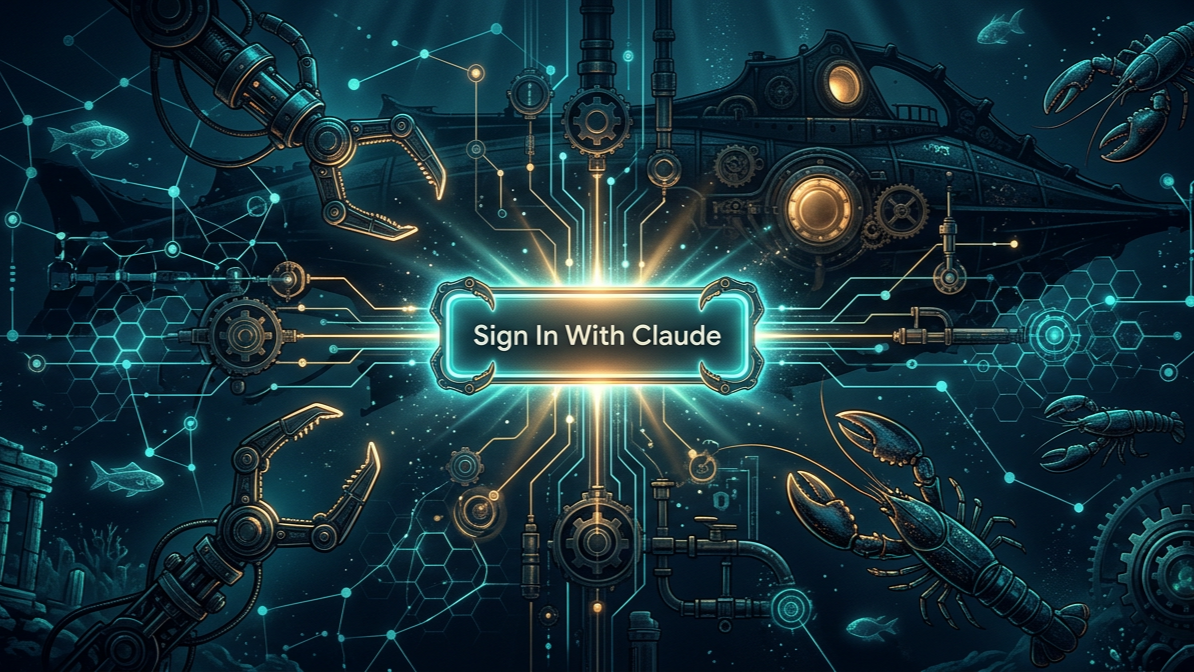
“Sign In With Claude.”
Imagine a single OAuth consent button — the same frictionless experience as “Sign In With Google” — that carries not just your identity, but your AI relationship. Your preferred model. Your inference budget. Your privacy preferences. Your billing authorization.
The user clicks it once. They consent to “this app may use up to $X/month of your Claude compute.” Everything else — the API authentication, the metering, the billing, the legal relationship — lives inside that OAuth handshake. The app developer never touches your API key. Never manages your billing. Never has to choose which model to use on your behalf.
They just call the endpoint. The provider handles the rest.
Why This Is Bigger Than It Looks
This isn’t just a UX convenience. It’s a distribution architecture.
For builders and indie developers: your MAU cost curve decouples from AI usage entirely. Scale to 100,000 users and your AI infrastructure cost doesn’t move. Users bring their own inference budget the same way they bring their own electricity. You build the outlets. They supply the power.
For users: your AI isn't someone else's product decision anymore. It's *yours* — your preferred model, your existing subscription, your trust relationship — traveling with you across every app that supports the standard.
For the provider who builds this first: every OpenClaw-enabled app that ships becomes an OAuth event on your platform. The network effect compounds fast. And unlike model quality — which competitors can match — identity infrastructure gets stickier the more apps adopt it.
That’s the Google playbook. And it works.
The Google Clock Is Ticking
Google has Google Identity — the most widely deployed OAuth provider on earth. They have Gemini. They have billing infrastructure. They have Android. If Google ships “Sign In With Gemini” with delegated inference billing before anyone else moves, they don’t just win the auth layer.
They win the default brain for every app on earth that wants AI without absorbing inference costs.
Huang compared OpenClaw's emergence to Linux. Linux won because it became infrastructure before anyone had a proprietary alternative fully deployed. The window to establish the open standard — the identity and billing layer for AI — is open right now.
It will not stay open forever.
What This Means For You
If you’re a product leader: the “whose AI bill is it anyway?” question is coming to your roadmap whether you plan for it or not. BYO-LLM isn’t a niche feature request. It’s an inevitable cost structure shift as inference becomes commodity compute.
If you’re an enterprise architect: NemoClaw’s OpenShell layer just gave you the security and privacy controls you’ve been waiting for to actually deploy agentic AI with confidence. The toolchain access problem is largely solved. The identity and billing layer is the remaining gap.
If you're a **builder or indie developer**: the most interesting apps of the next 18 months won't be the ones with the best AI. They'll be the ones that figured out how to make AI feel *personal* — the user's own, not the platform's — while keeping your infrastructure costs flat.
And if you’re at Anthropic: I have a feature request. The bug report form seems to have disappeared, so I’m putting this here.
Dr. Allen Partridge is Director of Digital Learning Product Evangelism at Adobe, where he works closely with the incredible team creating Adobe Learning Manager - and it’s agentic AI integration as an enterprise learning platform. If questions like “whose AI bill is it anyway?” keep you up at night in the context of workforce learning, Adobe Learning Manager might be worth a look.
*My other LinkedIn articles: *https://www.linkedin.com/in/doctorpartridge/recent-activity/articles/