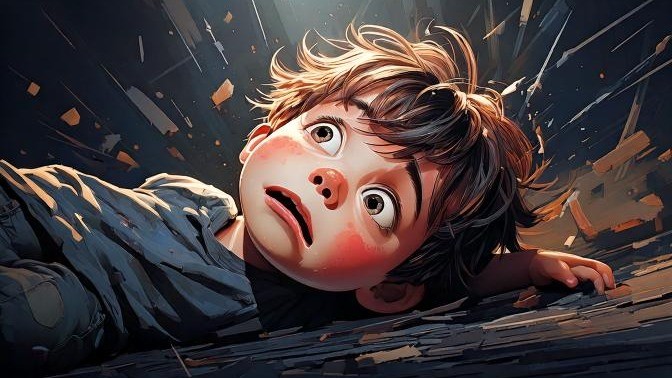
I remember the exact moment I first realized what it felt like to suppress my own emotions. I was five years old, still in kindergarten, navigating what felt like a towering jungle gym on our school’s playground. At that age, the monkey bars looked impossibly high. They were rusted around the edges, the paint chipping off in spots, but we all loved climbing them because they felt like an adventure—half fun, half terrifying.
One sunny afternoon, I reached for a bar and lost my grip. My hands slipped clean off the metal, and I landed hard on my back in the dusty gravel below. It hit me with such force that I lay there for a moment, totally breathless, staring up at the sky. Before that day, I never would have questioned whether I could or should cry. But then I heard the voices of the older kids, mostly boys, standing around me, looking down. “You’re not gonna cry, are you?” one of them asked, his tone half-mocking, half-challenging. I remember that surge of panic, an instant sense that if I let a single tear fall, I’d be branded as weak or different. So even though every part of me wanted to sob, I swallowed it all. I held my breath until the urge passed, then I struggled up to my feet as if it was nothing.
It was the first time I chose to hide my real feelings for fear of looking fragile. And, weirdly, I also recall how normal it felt. That was the bigger shock, that all the social cues told me: “Yeah, this is how it’s supposed to be. Toughen up.” A five-year-old doesn’t have the language or the life experience to label that moment as emotional suppression or toxic masculinity, but looking back, I can see how it planted the seed. It was the day I discovered there were unwritten rules about being a boy—rules that say you never show weakness, never cry, never let anyone see you soft.
Over the years, I started noticing how these rules were reinforced in more subtle ways. Boys who showed empathy or sadness were teased, called names, or told to “man up.” Even in TV shows and movies, the heroes rarely broke down unless it was some dramatic moment. Day-to-day vulnerability was apparently off-limits. That single moment on the playground came to symbolize how many of us, especially men, learn from a young age to bury our honest emotional responses. We don’t stop feeling, exactly—we just learn how to hide. And once the hiding starts, it spirals into a broader culture where empathy is undervalued, and looking strong is prized above all else.
When you follow that thread, you can see how it lays the groundwork for all sorts of power structures that rely on emotional illiteracy. If people don’t develop strong empathy skills, they can more easily treat others as objects or enemies. It’s no great leap from ignoring your own pain to ignoring someone else’s. In a black-and-white world of “don’t cry, just deal with it,” you can see how some become numb to suffering, or at least numb to suffering that isn’t right in their face.
That numbness can manifest in large-scale social or political movements. Think of certain fundamentalist or extremist groups that set themselves up as the moral authority. They can rely on followers who are too out of touch with empathy to question why some people get punished harshly or why certain rights are trampled. In the United States, for example, there’s been a lot of talk about the “religious right” or more recent nationalist strains where rigidity and dogma get elevated over compassion. It’s not always that every individual is cruel; it’s more that the culture itself often encourages shutting down the more vulnerable or questioning sides of ourselves.
I sometimes think back to that moment, me lying there on the gravel, gasping for air. Maybe if just one person had said, “Hey, it’s okay to cry if you’re hurt,” I would have seen a different path open up. Instead, I came away believing that tears meant I’d lose status or respect. Multiply that conditioning by millions of boys in playgrounds and households everywhere, and you begin to see how quickly a society can become desensitized. It’s not a coincidence that many men, having repressed their own vulnerability for years, end up at the very least indifferent to the vulnerabilities of others—and in the worst cases, actively hostile toward them.
This ties directly into phenomena like rape culture. Rape culture flourishes in environments where empathy is low and entitlement is high. It’s an environment that teaches men that they have a right to certain comforts—sexual or otherwise—and that complaining, crying, or calling them out is a sign of weakness from the other side. If from childhood you’re steeped in the idea that showing hurt is for “losers,” you’re not primed to empathize with anyone who says, “You’ve hurt me.” Instead, you’re primed to question their credibility, to view them as overreacting, or to treat them as obstacles. When you look at religious or political fundamentalist movements that support patriarchal control, you see the same pattern: push people to fear emotional expression, then use that fear to keep them from empathizing with outsiders or victims.
It sounds dire, and often it is. But there’s always a possibility for change. One interesting approach people talk about is the “Lysistrata” strategy—named after an ancient Greek play in which women refuse sexual relations with men until they stop waging war. Translated into modern terms, that might look like a collective refusal of intimacy and emotional support for men who refuse to develop empathy or respect boundaries. It’s less about punishing men as a whole, and more about withholding validation from those who won’t do the internal work to unlearn toxic behavior. It’s meant to jolt them into realizing there are real consequences for remaining emotionally stunted or abusive.
Some folks argue that this approach is too extreme. Yet when you look at how deeply ingrained the “you’re not gonna cry, are you?” mindset is, you start to wonder if a dramatic reset might be necessary. Rape culture and patriarchal fundamentalism don’t just evaporate because we ask nicely. They’re embedded in families, religious institutions, media, and laws, and they’re buttressed by generations of men who learned, as young as five, that tears and tenderness are shameful. So a bold strategy like refusing to support or engage with that attitude might be just the kind of wake-up call needed.
At the same time, you don’t want to demonize an entire gender. A lot of men genuinely do want to change. They may remember their own “monkey bars” moment—the day they fell, felt humiliated, or were told not to cry—and wish they could have done things differently. It can feel daunting to break out of a pattern that has been hammered into you since you were tiny. That’s why discussions of therapy, emotional support groups, and open conversations matter. If men see role models who cry when they’re upset, who treat empathy as a strength, and who challenge patriarchal norms, it can help rewire those childhood lessons.
Personally, I think about that day when I was five, and sometimes I get this pang of sadness for that little kid. I wish he’d known that being emotional was okay, that the lump in his throat was just his body’s way of expressing hurt, and that it was healthy to let it out. Instead, he was given a crash course in how to bury his feelings. And from there, it’s just a hop, skip, and jump to all the bigger problems—like normalizing violence, excusing abuse, letting fundamentalist ideologies go unchallenged, and ignoring the pains of entire groups of people.
So how do we address all this? It has to be tackled on multiple levels. Politically, we need laws and structures that don’t shield abusers, that actually hold powerful people accountable, and that encourage equality. Socially, we need to dismantle norms that mock or penalize emotional expression. Educationally, we need to teach kids the value of empathy and the skill of communicating their feelings. And on a personal level, we can’t underestimate the power of small acts—like telling a crying child, “It’s okay, let it out,” or having conversations that validate emotional vulnerability as part of real strength.
When I connect this back to the bigger picture of fundamentalism, whether it’s religious or ideological, I see how a lack of empathy and emotional intelligence greases the wheels of authoritarian systems. If you can’t or won’t empathize, you’re less likely to stand up against cruelty. You’re more likely to stick with your group, demonize the “other,” and accept harsh punishments for those who don’t conform. Meanwhile, if you start to build a culture that values emotional depth, it becomes harder for leaders to use fear and shame to control people. Questions get asked. Compassion leads to demands for justice. People start saying, “Wait, isn’t that policy cruel?” or “Doesn’t that rhetoric encourage violence?” That’s dangerous for any hierarchy that depends on blind obedience.
On a personal note, the years after my playground incident were a mix of trying to conform to that “strong boy” persona and occasionally butting up against it. It always felt unnatural to bury my emotions, even though I knew that was the rule. Once in a while, some adult—usually a teacher or relative—would notice and give me permission to cry or talk about my feelings, and it was the biggest relief in the world. But in the broad scope of my everyday environment, the older boys, the TV shows, the peer pressure, all hammered home the same old message: “Don’t be soft.”
That message forms the bedrock of a cultural system that downplays empathy, from small playground interactions to the corridors of power. If kids keep hearing it, they grow up into adults who might genuinely believe empathy is optional—or who reserve it only for people exactly like them. And that’s how fundamentalist mindsets grow. If you only see the world in terms of who’s “strong” and who’s “weak,” or who’s “faithful” and who’s “sinful,” you miss the common humanity that binds us together.
Rape culture, in many ways, is the vile expression of this emotional gap. If you can’t see women as full human beings with their own autonomy and pain, then it’s easier to ignore their consent. If you can’t feel genuine outrage that someone was assaulted, because you’ve numbed yourself from age five onward, then you might side with the abuser. If you’ve been taught that real men dominate rather than understand, you create an environment where violence against women, or indeed any perceived weaker group, isn’t taken seriously. Fundamentalist doctrines compound that by saying it’s “God’s plan” for men to rule and women to submit, which only reinforces the emotional blind spot.
All of this can feel overwhelming, but I hold onto hope that we can slowly unravel these threads. Efforts to promote empathy in schools, calls for better representation of emotional vulnerability in media, grassroots activism against oppressive laws, and yes, even the more dramatic “Lysistrata-style” actions can all chip away at the old model. After all, what’s at stake here is the ability of children—like my five-year-old self—to grow up believing that their tears aren’t a sign of weakness, that caring about other people is a kind of strength.
It’s not a quick fix. We’re talking about cultural and personal change on a massive scale. Still, every time one person decides to defy the “don’t cry” rule, or calls out a friend for a sexist joke, or refuses to support leaders who thrive on fear, the culture shifts slightly. Maybe someone else sees that example and thinks, “Well, if they can do it, maybe I can too.” And that’s how revolutions in thought and behavior often start: one small moment at a time.
The day I fell off those monkey bars, I truly believed I had no choice but to silence my tears. If I’d realized I did have a choice—to cry, to let my pain and fear be seen—I might have found a different kind of strength a lot sooner. And that’s the heart of it: letting ourselves and each other see that there is power in vulnerability, that empathy is a crucial skill, and that a society built on those values might just undo the toxic legacy that’s crept into everything from fundamentalist politics to daily interactions on a playground.