I’ve been doing this for a long time. Decades in learning tech. And every once in a while, something comes along that makes me stop and say *“wait… they actually did that?” *This is one of those moments.
The Hidden Superpower
You know Experience Builder in Adobe Learning Manager - the tool for creating custom learner landing pages. Drag, drop, make it pretty. Great stuff.
But here's what I didn't expect: **the product and engineering team exposed a rich client-side SDK for building custom experiences.**
I’m talking about JavaScript injection on the front page. Not some sandboxed, limited “here’s a few things you can customize” situation - a real SDK with authentication context, user data, navigation control, and theme awareness.
What You Actually Get
When I started exploring, I found:
Authentication Context
- CSRF tokens for secure requests
- Native extension tokens (same format headless integrations use)
- Session state checks
Read Access to User Data
- Current learner’s profile (name, email, avatar)
- Enrollment counts, completion stats
- Badges earned, gamification points
- Custom profile fields
Full Navigation Control
- Catalog, My Learning, Skills, Badges, Leaderboard
- Social Learning
- Your custom Experience Builder pages
- Training overview pages
Configuration & Theming
The REST API endpoint URLDOM mounting points for componentsThe complete theme object - colors, fonts, brandingWidget system configuration
What It Doesn’t Do (Let’s Be Real)
This is a learner-facing SDK. It’s not an admin backdoor.
You can’t upload courses or content. You can’t create badges or certifications. You can’t modify someone else’s scores or completions. You can’t access admin-only endpoints.
The token is scoped for reading user context and navigating - not writing administrative data. That’s actually good design. You get enough power to build amazing personalized experiences without creating security nightmares.
What I Built in an Afternoon
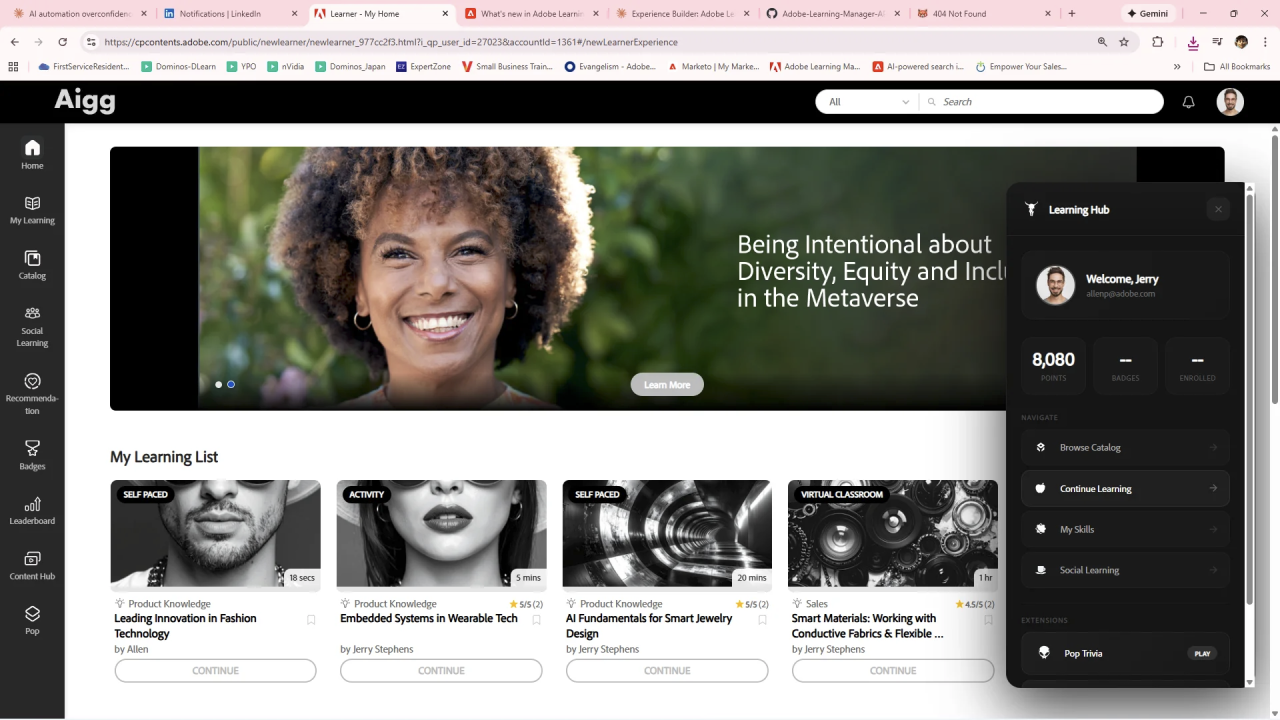
To prove this wasn’t just theoretical, I built a “Learning Hub” panel that floats over any ALM page:
- Greets learners by name with their avatar
- Shows real-time stats (enrollments, completions, badges, points)
- Provides quick navigation to any part of ALM
- Opens external tools (quizzes, badge makers) in iframe popups
- Reads the instance theme and styles itself to match
And the whole thing is about 600 lines of JavaScript.
Where This Gets Interesting
The real power isn’t reading data - it’s what you do with that data.
- Personalized Experiences. Know who the learner is, what they’ve completed, where they’re struggling. Surface the right content at the right moment.
- External Integrations. Call your own APIs. Pull in recommendations from an AI service. Connect to your company’s internal tools. The fetch API works fine.
- Gamification Overlays. Build leaderboard widgets, achievement popups, progress visualizations - all driven by real ALM data.
- Interactive Extensions. Pop Trivia, Badge Maker, custom calculators - anything that runs in an iframe can be launched without leaving ALM.
The Practical Stuff
I’ve open-sourced everything:
📦 https://github.com/increasinglyHuman/ALM-FrontPageJSInjection
It includes:
- The complete Learning Hub injection script
- Documentation on what the SDK actually exposes
- An ELI5 guide explaining how each piece works
- Example templates for building your own extensions
MIT licensed. Use it, fork it, learn from it.
The Bigger Picture
Experience Builder in Adobe Learning Manager was already useful for creating custom landing pages. But this JavaScript capability transforms it from “page customization” to “experience extension.”
You can now:
- Build features that don’t exist yet
- Create integrations specific to your organization
- Prototype ideas and test them immediately
- Solve problems no vendor could anticipate
And you can do it today. No waiting for feature requests. No complex backend integrations. Just JavaScript, the SDK the product team provided, and your imagination.
What Will You Build?
I’m genuinely curious what the community does with this. Tag me when you launch something. Share your experiments. Let’s figure out together what’s possible. Because the best innovations in learning tech rarely come from vendors alone. They come from practitioners solving real problems with the tools at hand.
Let's see what we can build.
Dr. Allen Partridge is Director of Product Evangelism at Adobe, focusing on Adobe Learning Manager.